Silent brainstorm
Brainstorming is one of many ideation methods and will help a group generate many ideas in a short timeframe. While brainstorming, you’re in divergent thinking mode, which will help you create new and innovative solutions. For this play, you can start with a problem statement, point of view or a how might we question.
In silent brainstorming, participants ideate individually before sharing and discussing their ideas. Silent brainstorming is a common way to run a brainstorm as it has many benefits:
- It provides multiple perspectives around a given problem
- Ensures you gather a lot of ideas before pursuing any specific ideas
- Participants' expertise and ideas are equally considered
- It produces significantly more ideas than brainstorming out loud, and the ideas tend to be more creative and of higher quality.
- It is helpful for introverts or people who are uncomfortable speaking up in a workshop.
- Because the ideas are written down (or drawn, if preferred) by the participants themselves during the silent brainstorm, we are certain that every idea will be documented along the way.
- There is flexibility around the output of the silent brainstorm – you can ask participants to either write or draw or give the option to do either. This will make the play useful for many different things, from a service to specific product feature.
Tip
 The silent brainstorm play is a part of our Ideation game plan, which also include the following plays: “how might we...”, “grouping” and “dot voting”.
Outcomes
- A large number of ideas generated in a short timeframe
- Potential ideas that can be developed into testable prototypes or experiments
- Individual ideas that can inspire new ideas in other people
What you need
| Remote | In-person |
|---|---|
|
|
Instructions
Prep
For this play, there is a small amount of preparation required to help your participants understand the goal and get the most out of the session.
You will need to gather some insights about the problem space the team are working on, reframed as a “how might we...” or problem statement.
Run the how might we play to help create one before going ahead with Silent Brainstorming.
Invite your participants
Aim for including a range of people to form a multi-disciplinary team. The more diverse the experiences and perspectives of the people around the table, the richer the ideation outcomes will be.
Participants in this session should be made up of the project team and any subject matter experts relevant to the project. This might include a Project Manager (PM), Project Officer, Designer, Business Analyst, Communications Officer, Solution Architect, or Developer. You can still run the session if you don't have all of these team members available but aim for as much diversity as possible.
You’ll want to make sure when you send an invite for the session, that you clearly explain the goal, how long it’ll take, and why people’s participation will be beneficial. You can use the provided template to make it easy. If you have already created a “how might we...” question in an earlier session, including the same participants to the brainstorming session is beneficial so that they get a chance to share their ideas.
It’s important to give enough notice to ensure participants have free time to come along to the session. Aim to send invitations about 2 weeks in advance.
You can also attach the play for people to look at ahead of time
Calendar meeting request for silent brainstorming
Subject:
Join us for a silent brainstorming session for [project name]
Meeting description:
Hi [team name if sending a group invitation, or participant name if sending individual invitations]
As part of [name of project] we have recently defined a [problem or how might we] statement and are looking to generate some new and innovative solutions.
The session will take about [x] minutes and there is no preparation required.
Having [you/each of you] attend will help to generate a large number of potential ideas that can be developed into testable prototypes or experiments. We will be [using Miro for this workshop/gathering in-person] and you can read more about the silent brainstorming session in the Digital service design playbook.
I look forward to your contribution to the session. [If you’re planning to record the session include the following - We will be recording the session for learning and development purposes and recordkeeping. Please let us know before the session if you don't want to be included in the recording or transcript].
The [Project name] team is committed to inclusion for our workshops, and we appreciate the experience of inclusion is not the same for everyone. Please let us know what we can do to make our sessions more accessible and inclusive for you.
Kind Regards,
[Facilitator name]
Setting up the tools
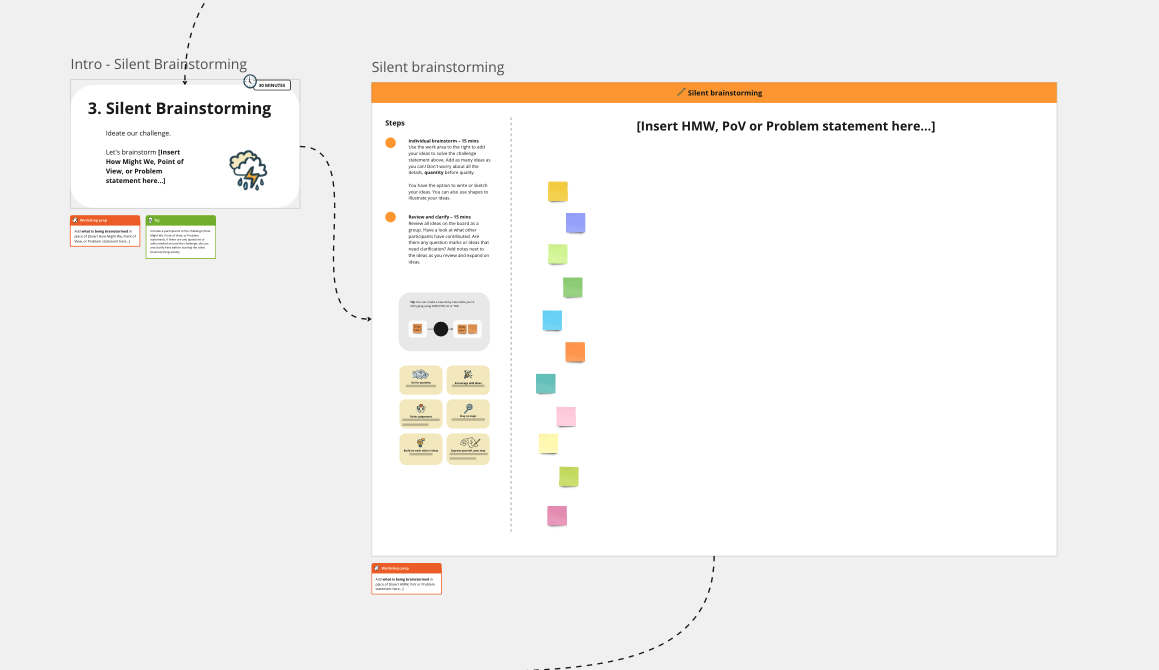
For remote teams, use this Miro board: Silent Brainstorm Miro.
For in-person teams, you will need a booked meeting space, sticky notes (one pad per participant), markers (one for each participant) and a whiteboard, wall, or butcher paper to attach the sticky notes. Even if you are working in-person, consider reviewing the Miro template to get an idea of how we suggest running the Play.
1. Introduction – 10 mins
If using Miro, check that everyone knows how to navigate and use the board.
Welcome the team and start by explaining the goal, expected outcomes, and what activities that you will run in the session.
2. Creative warm up - 10 mins
Explain to the participants that a warm up activity is a quick and playful activity before jumping into the brainstorm. This will get people ready for the divergent thinking that they need to do for the rest of the session.
Warm up option 1 (works in remote or in-person settings): This n’ that
In this activity, participants will try to come up with creative solutions by combining 2 different objects. This warm up activity will encourage creative thinking and combining unusual concepts. This will encourage participants to share crazy ideas and build on each other's concepts.
Warm up option 2 (works best in remote setting): Our ideation monster
In this activity, participants collaborate to create a representation of what they think a fictional ideation monster might look like. This playful warm up activity will encourage creative thinking and collaboration. It is also very useful to help remote participants get used to moving objects on a virtual board.
3. Silent brainstorming – 30 mins total
Introduce the chosen “how might we...” question (or problem statement or pain point) to the participants and explain how you got to this outcome in earlier sessions. Explain that this question or statement will be the core question for the silent brainstorming activity.
Brainstorming activities are meant to be full of ideas, and there is no such thing as a bad idea. The more ideas we have, the better! Show and walk through the rules of our “rules of Ideation” poster. A high resolution version can be downloaded here.
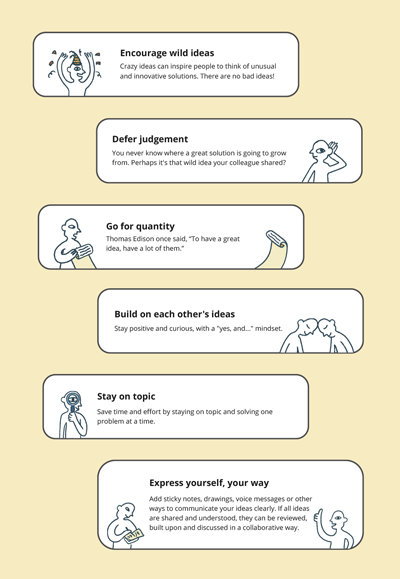
Ideation guidelines – a quick guide on how to get the most out of silent brainstorming
Also let participants know that they should use one idea per sticky note, and that ideas need to be clear and specific. For example, ‘education' is not specific enough. It needs to be clarified further, like this: 'HCD learning posters in every office', 'explainer videos to educate staff' and so on.
3a. Individual silent brainstorming: 15 mins
This is an individual exercise, and the participants will be working on their ideas in silence.
With the focus question in mind, ask the participants to write or draw as many ideas as they can on sticky notes (virtual or real depending on workshop location), within the set timeframe.
Tip
If the group agrees, you can put some background music on while people are brainstorming. Another option is to have some upbeat music come on when time is up.
Let participants know they can still ask questions during this time. In a remote setting, ask participants to write their questions or comments in the chat, and for in-person settings they can signal the facilitator over.
Don't forget to start the timer!
Tip
Avoid clustering or grouping sticky notes too early, to make sure participants have a chance to think freely outside of defined groups. For more information around this see the grouping play.
3b. Review ideas and clarify as a group: 15 mins
Review all the shared ideas together. The purpose of this part of the play is to make sure every idea is easy to understand. Encourage participants to share, discuss, ask questions, and build on each other’s ideas. This part is where ideas can grow and evolve before moving to the grouping stage.
This is a good time to ask questions around ideas or get people to expand on anything that’s unclear. As the facilitator, target sticky notes that are unclear or unfinished, and encourage the people that wrote them to elaborate further. Here it is useful for the facilitator to act as a scribe for the group, to quickly add extra notes to an idea.
4. Wrap up – 5 mins
Thank everyone for their time.
Remind participants that this play was all about using a diverging mindset (creating choices) by creating a multitude of opportunities for solving a problem.
The next steps will involve activities that help guide your team in making shared decisions from today’s outcomes and converging on a chosen idea to explore further.
Let the participants know that if they have any final thoughts or questions, they can add them to the Miro board (on the last slide) or send you an email. This is useful in case you are running out of time towards the end of the session.
Debrief
After the session, the facilitator and core project team may need to debrief or do data management from the brainstorming session.
Follow Up
After this play, you can choose to share the outcomes with the participants in a follow-up email. This would either be an exported PDF of a virtual Miro board, re-sharing the Miro board link, or sharing photos of the physical sticky notes from an in-person session (you could save these in your project files in Teams).
Make decisions
After the silent brainstorm play, you could use grouping or dot voting to help you reach a shared decision in your team.
Resources
See below for a collection of templates and other pages which will help you run this play. These resources are also linked in the play instructions.
Subject:
Join us for a silent brainstorming session for [project name]
Meeting Description:
Hi [team name if sending a group invitation, or participant name if sending individual invitations]
As part of [name of project] we have recently defined a [problem or how might we] statement and are looking to generate some new and innovative solutions.
The session will take about [x] minutes and there is no preparation required.
Having [you/each of you] attend will help to generate a large number of potential ideas that can be developed into testable prototypes or experiments. We will be [using Miro for this workshop/gathering in-person] and you can read more about the silent brainstorming session in the Digital service design playbook.
I look forward to your contribution to the session. [If you’re planning to record the session include the following - We will be recording the session for learning and development purposes and recordkeeping. Please let us know before the session if you don't want to be included in the recording or transcript].
The [project name] team is committed to inclusion in our workshops, and we appreciate the experience of inclusion is not the same for everyone. Please let us know what we can do to make our sessions more accessible and inclusive for you.
Kind Regards,
[Facilitator name]
