Stakeholder mapping
Stakeholder mapping helps you reflect as a team to identify stakeholders, their roles, and the relationships between them in order to communicate and work with them more effectively. Use this play as early as possible to make sure your team have a clear understanding of who is relevant to any given piece of work.
What is a stakeholder map?
A stakeholder map is a visual representation of the ecosystem of stakeholders involved in a user experience. It helps to understand who is involved, to reveal existing formal and informal relationships between stakeholders, to identify frictions between them, and to find new business opportunities by establishing new relationships, fostering existing ones, or creating alternatives.
Why do I need a stakeholder map?
Stakeholder maps can be used to analyse and understand who is involved in a project or organisation, and how these people, organisations and aspects are connected. Most projects are influenced by a large number of different stakeholders. Understanding their perspectives and how they are connected can help to better manage the different expectations and ensure you include the relevant stakeholders at appropriate stages of your project. A stakeholder map is also often the first step towards defining and clarifying who your key users are for a project.
Outcomes
A visual map of:
- stakeholders involved in, and impacted by our project
- key users defined for our project (who we are designing for)
- the relationships between the stakeholders and key users
- A starting point that will help us form a RACI and communications plan
What you need
| Remote | In-person |
|---|---|
|
|
Instructions
Find support
Because a stakeholder map is an overview, you don’t need to ensure you have all the subject matter experts for all parts of the service in the room at the same time. In fact, that might be counterproductive. Instead, try to find the balance between a small enough team and enough breadth of knowledge so that you can be somewhat confident that your first attempt at a stakeholder map is close. Don’t aim for perfect.
Invite your participants
Aim for including a range of people to form a multi-disciplinary team. Participants in this session should be made up of the project team and any subject matter experts relevant to the project. This might include a Project Manager (PM), Project Officer, Designer, Business Analyst, Communications Officer, Solution Architect, or Developer. You can still run the session if you don't have all of these team members available but aim for as much diversity as possible.
You’ll want to make sure when you send an invite for the session, that you clearly explain the goal, how long it’ll take, and why people’s participation will be beneficial. You can use the provided template to make it easy.
It’s important to give enough notice to ensure participants have free time to come along to the session. Aim to send invitations about 2 weeks in advance.
You can also attach the play for people to look at ahead of time.
Calendar meeting request for stakeholder mapping
Subject:
Join us to create a stakeholder map for [project name]
Meeting description:
Hi [team name if sending a group invitation, or participant name if sending individual invitations]
As part of our project kick-off
Having you attend will help us to identify the stakeholders across the different stages of our [product/service].
The session will take about [60] minutes and there is no preparation required.
We will be using Miro for this workshop and you can read more about stakeholder mapping in the Digital service design playbook.
I look forward to your contribution to the session.
Kind Regards,
[Facilitator name]
Setting up the tools
For remote teams, use the Miro template provided.
For in-person teams, you will need a booked meeting space, sticky notes (one pad per participant), markers (one for each participant) and a whiteboard, wall or butcher paper to attach the sticky notes. Even if you are working in-person, consider reviewing the Miro template to get an idea of how we suggest running the Play.
1. Introduction – 10 mins
Set the stage by explaining the focus of your project. In order to create a stakeholder map, it is important to define the scope and goal of your project first. For example, let’s say the scope of your project is to understand and improve the user experience of your service.
2. Warm up – 5 min
This quick activity is great for getting used to the Miro board and is also a good way to record workshop participants that are attending the session.
Using the sticky notes, ask participants to add their names on top of the location they would like to spend their next holiday.
3. List stakeholders – 20 mins Total
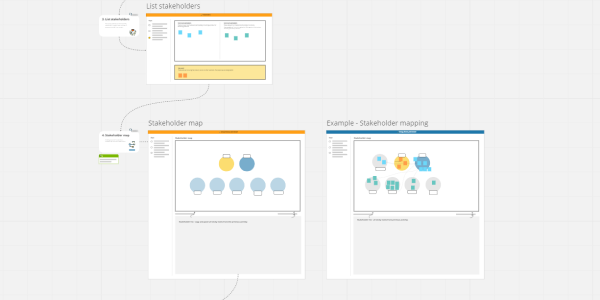
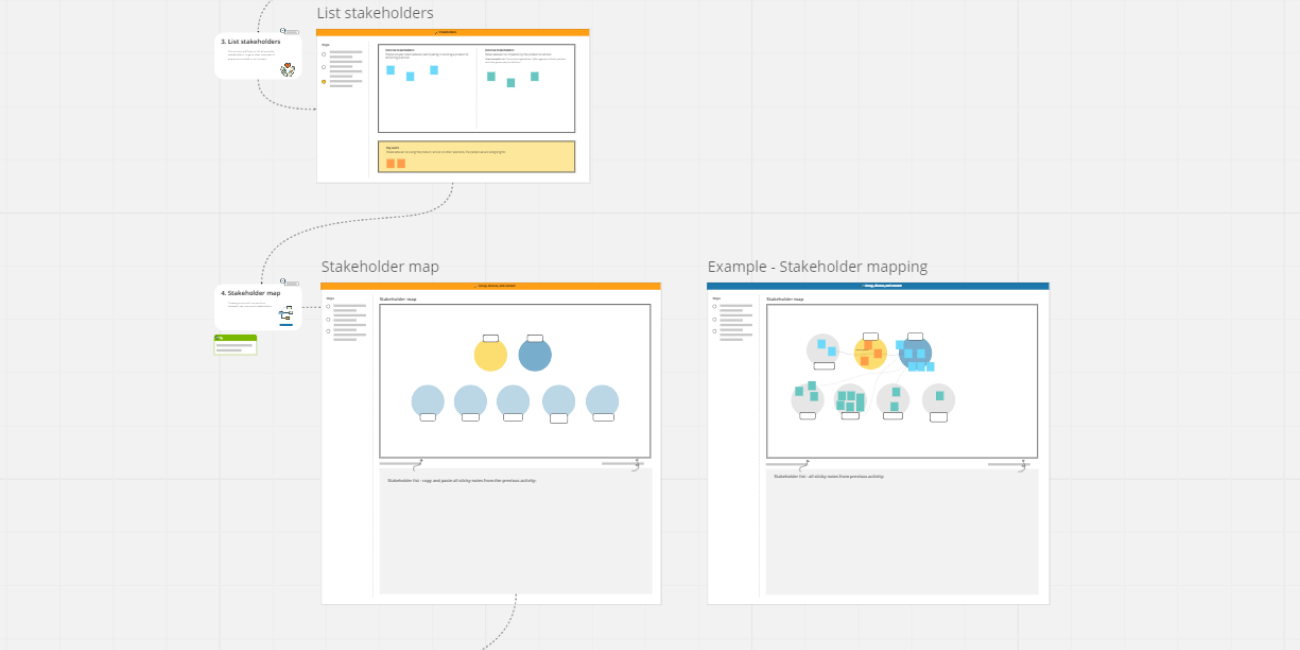
On your whiteboard, whether that’s a virtual or physical one, identify the stakeholders involved with or impacted by the project. These may be people or a team within in TMR, a team, or an industry group. Make sure to include specific names and roles. Do this individually and silently at first.
Refer to previous example to give examples of stakeholders. We’ll use the same example in the Miro template.
3a. Individually, list all possible stakeholders – 5 mins
Add stakeholders into the groups provided.
3b. Discuss – 10 mins
Look at all the people who have been identified. Are there any that overlap? Did you miss anyone?
3c. Decide - 5 min
Who are our key users for this project? Who are we designing for?
4. Stakeholder map – 30 mins total
4a. Group the stakeholders – 10 mins
Ask everyone to move the stakeholders into the groups provided in the Miro template. Let the group know they can create more groups if required.
4b. Converge and discuss – 10 mins
Look at all the people you’ve identified so far. Are there any that overlap? Did you miss anyone? Come together as a team and make sure you have all of your stakeholder documented.
4c. Make connections – 10 mins
Draw arrows between the clusters to describe relationships between groups. You can also cluster, circle, and label related groupings.
Refer to previous TMR example. Give a couple of examples of connections between stakeholders.
5. Wrap up – 5 mins
Thank everyone for their time. Let them know that you will use this stakeholder map to ensure the right people are involved and informed about the project.
Make a comms plan
Use the stakeholder map to determine which stakeholder groups should be engaged for collaboration, and which groups need to be informed. Create a communications plan which outlines who you will communicate with, and the medium and frequency of communication.
Make a RACI
Analyse the stakeholders who will be involved in delivering the project to determine if they are responsible, or accountable, or if they should be consulted or informed.
Resources
See below for a collection of templates and other pages which will help you run this play. These resources are also linked in the play instructions.
Subject:
Join us to create a stakeholder map for [project name]
Meeting Description:
Hi [team name if sending a group invitation, or participant name if sending individual invitations]
As part of our project kick-off, we’ll be running a stakeholder mapping workshop to identify our stakeholders and the relationship between them in order to communicate with them more effectively.
Having you attend will help us to identify the stakeholders across the different stages of our [product/service].
The session will take about [60] minutes and there is no preparation required.
We will be using Miro for this workshop and you can read more about stakeholder mapping in the Digital service design playbook.
I look forward to your contribution to the session.
Kind Regards,
[Facilitator name]
